When a roof needs replacing rather than restoring
Restoration coats what is there. Replacement takes it off and starts again from the rafters. We recommend replacement when concrete tiles are soft through, terracotta is fretting and shedding glaze, battens have sagged so the courses run wavy, a metal roof is rusted through at the laps, the roof is asbestos cement, or the owner wants to go from tile to metal for the weight, the look or a long leak history. If you are on the fence, restore or replace sets out the tests we use, and how long each roof type lasts gives the realistic numbers.
Tile to Colorbond conversion
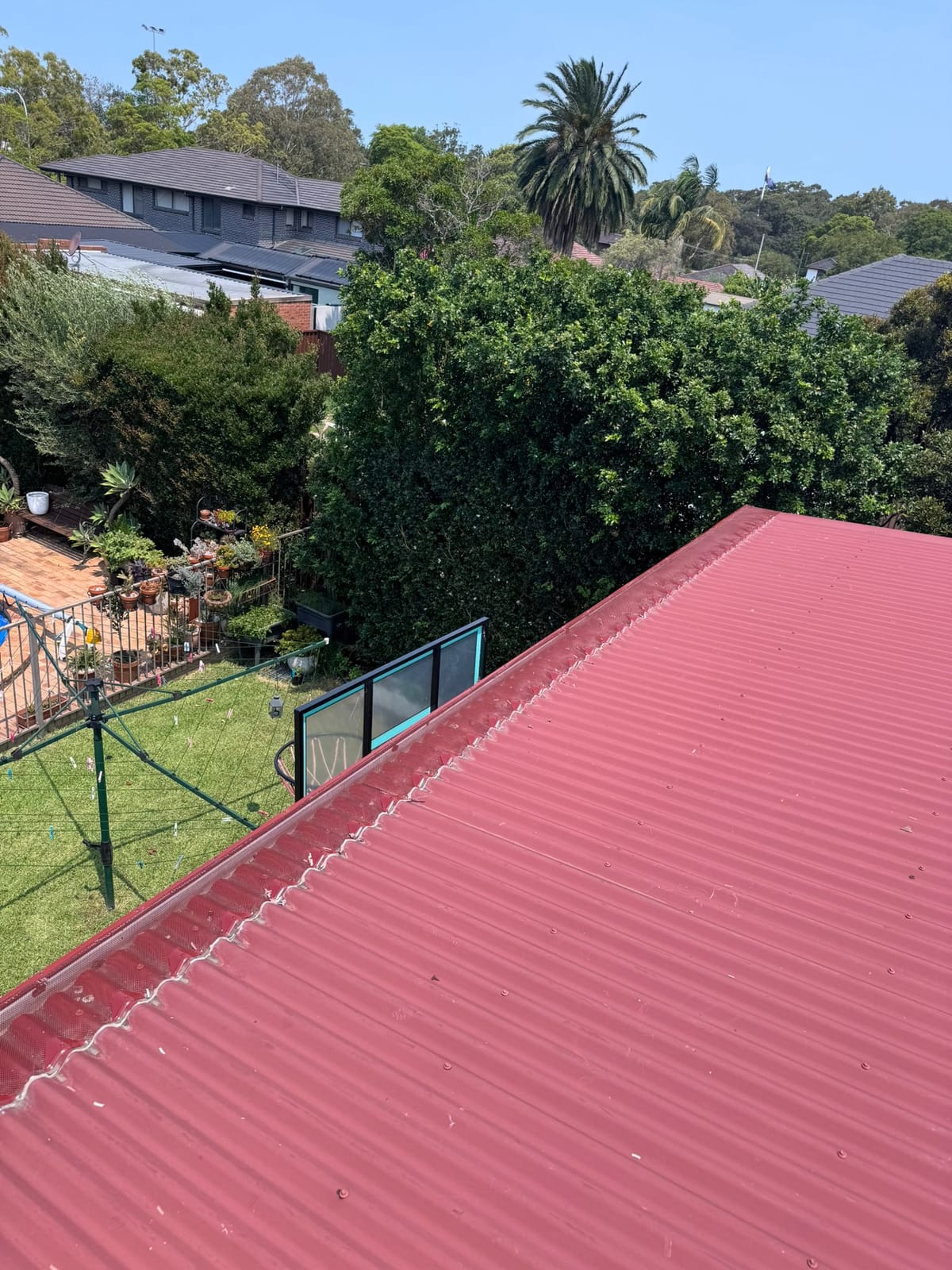
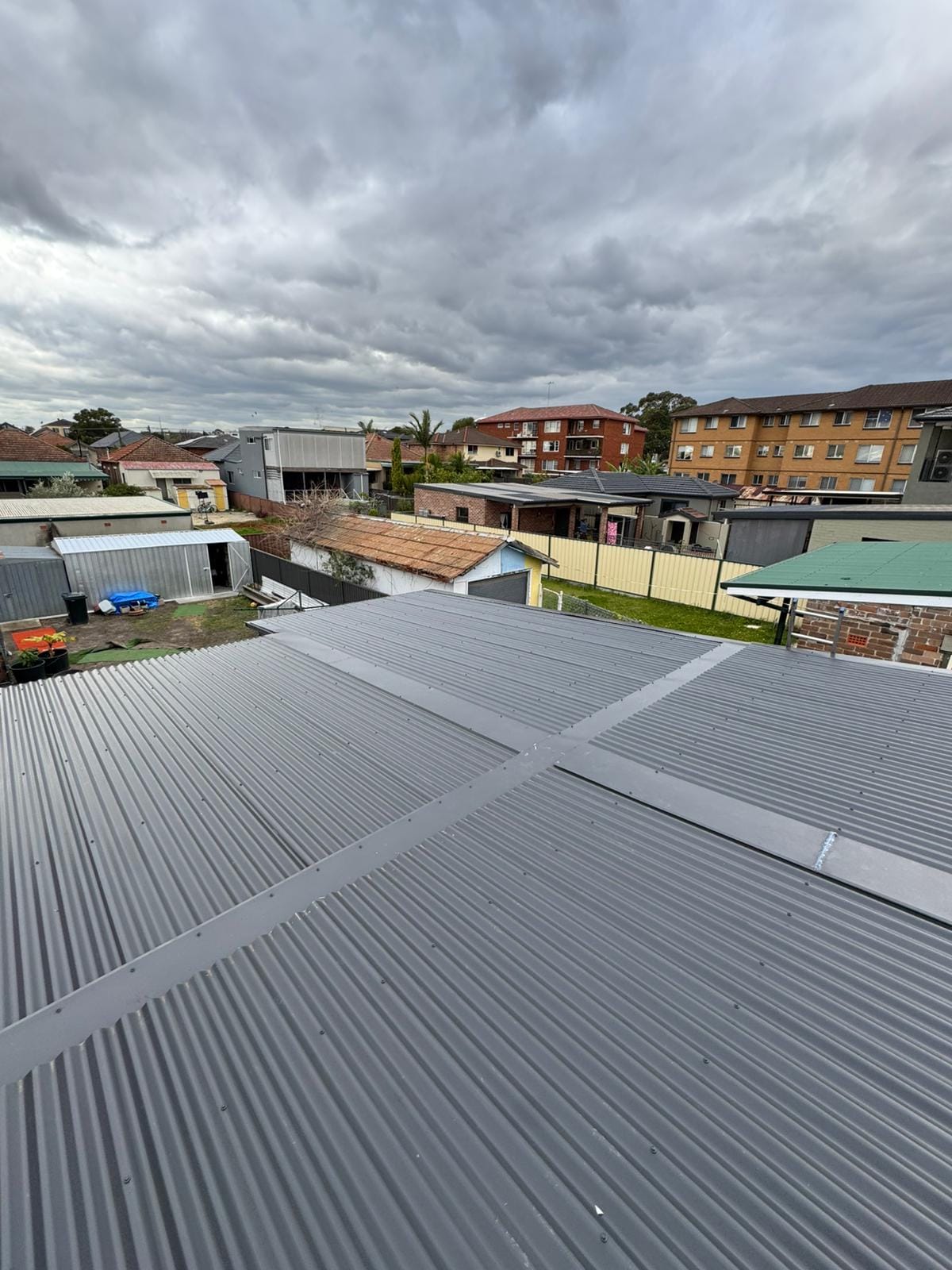
Most re-roofing we do in Sydney is a tile to Colorbond conversion, and it is more than swapping one covering for another. Tiles sit on battens at roughly 320 mm centres; Colorbond needs battens at up to 900 mm centres, fixed to carry the sheet, and the roof loses around 40 to 50 kg per square metre. The structure is usually fine with that, but rafter spacings need checking and occasionally a purlin added, and we look at that at the quote, not after the tiles are off.
The sequence on site:
- Scaffold or edge protection is set up to AS/NZS 1891, and the ceiling space is protected from falling debris where there is no sarking.
- Tiles, ridge caps and old battens are stripped and loaded straight into the skip. A 200 m² tile roof is around 8 to 10 tonnes of waste.
- Rafters and trusses are inspected. Rotten or split members are sistered or replaced; this is a variation only if we find something we could not see at the quote.
- New sarking is laid over the rafters to AS 4200.1; on a metal roof that is a foil-faced anti-condensation blanket, because a bare metal underside sweats on cold nights and drips onto the ceiling.
- New treated timber or steel battens are fixed at the spacing the sheet profile and pitch require.
- Sheets are laid starting from the end away from the prevailing weather, screwed through the crest with Class 4 fasteners, with correct end laps and turned-up ends at the ridge.
- Ridge capping, barge capping, valley gutters, flashings around every penetration, and new fascia and gutter are fitted. Downpipes are reconnected.
- The site is magnet-swept for screws and the skip removed.
The whole job on an average home takes four to seven working days. We take the roof off in sections so the house is never open overnight, and if rain arrives mid-strip the tarps go on immediately.
Profiles, grades and products
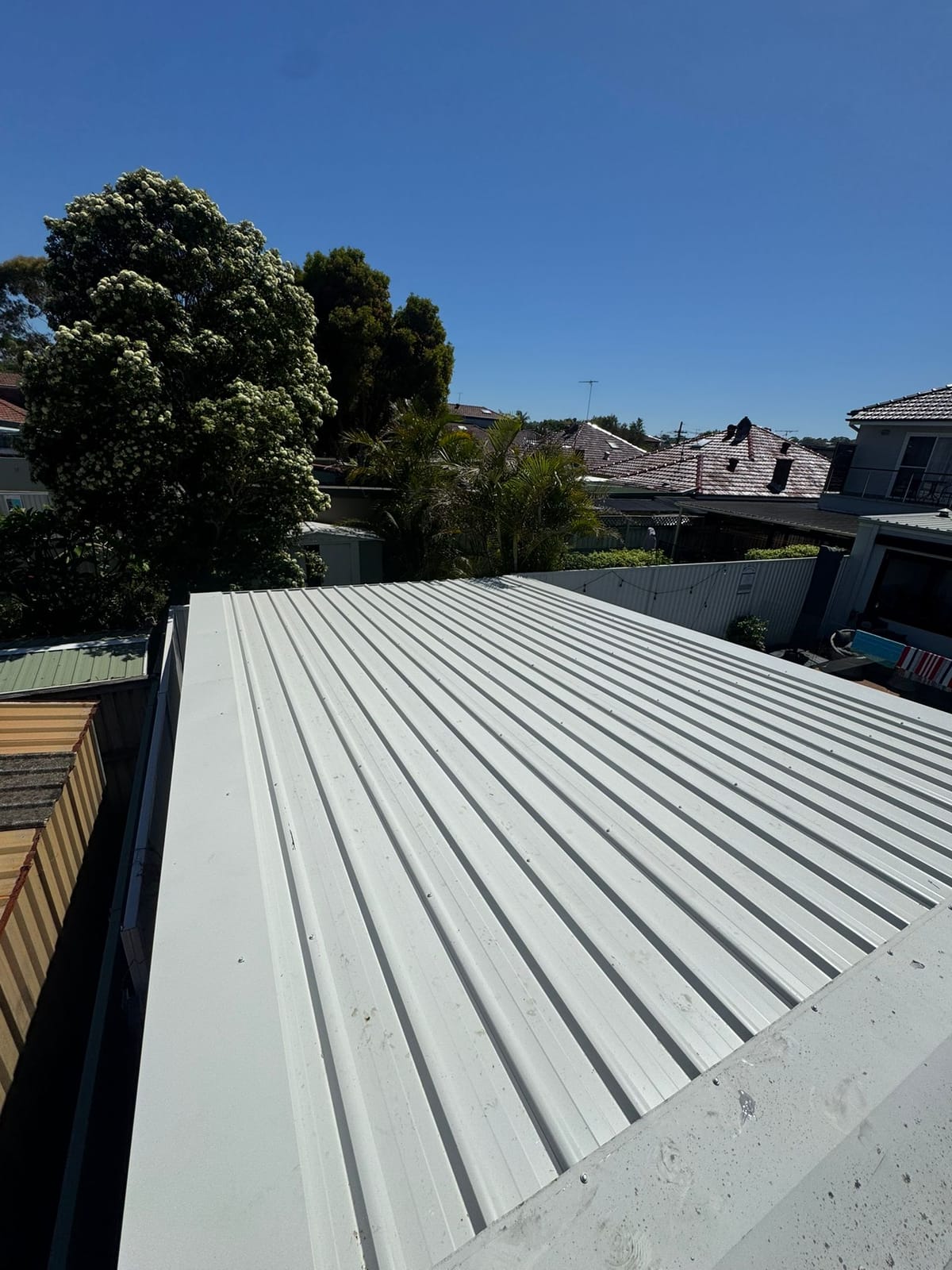
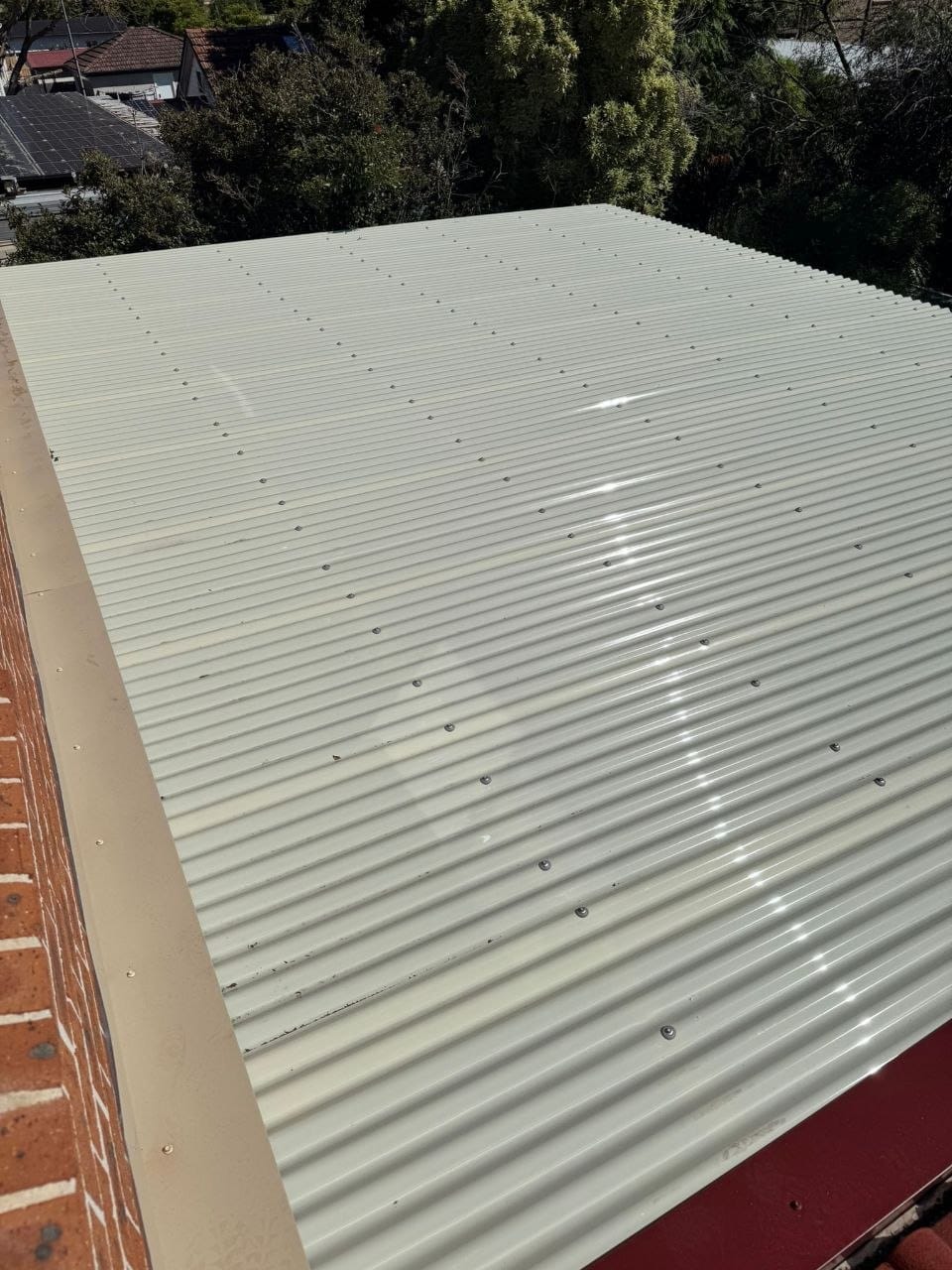
Two profiles cover most Sydney homes. Lysaght Custom Orb is the corrugated sheet that looks right on Federation, weatherboard and heritage houses and is rated down to 5 degrees of pitch. Trimdek is a squarer trapezoidal profile with a more contemporary look, rated down to 2 degrees, and often the better choice on low-pitch 1960s and 70s roofs where corrugated would be marginal. Both come in the full Colorbond range; see our Colorbond colour guide.
Standard Colorbond steel carries a BlueScope warranty of up to 36 years depending on the environment. Within about a kilometre of surf, or on the harbour foreshore, we specify Colorbond Ultra, which has a heavier metallic coating for salt exposure and adds from 20 per cent to the sheet cost. On the Northern Beaches, at Cronulla and along the Eastern Suburbs coast it is not optional if you want the warranty to hold; the metal roofing page goes into grades in more depth.
We also re-tile: new concrete or terracotta tiles on new battens and sarking, for owners who want to keep the look or are in a heritage area where the streetscape requires it. See tile vs Colorbond for how the two compare, and our tile roofing page for the options.
Insulation R-value
With the roof off is the cheapest moment you will ever have to insulate. The Building Code sets a minimum insulation R-value for the roof and ceiling in Sydney's climate zone. On a metal re-roof the anti-condensation blanket contributes part of it (typically R1.3 to R1.8), and ceiling batts make up the rest. Ask for the combined R-value in writing on the quote. A light colour such as Surfmist cuts roof-cavity temperature further and is worth choosing on west-facing roofs in the Hills and Western Sydney.
Asbestos roof removal
Any roof or eaves built before 1990 may contain asbestos cement; corrugated Super Six sheeting is the common one. Removal of more than 10 m² must be done by a licensed asbestos removalist under SafeWork NSW rules: sheets are wetted down, removed whole, wrapped and taken to a licensed facility, and a clearance certificate is issued before we start the new roof. We coordinate the removal as part of the re-roof. Asbestos roof removal adds from $60 per m² to the job and one to two days to the program.
Council approval and heritage areas
A like-for-like re-roof in the same material is generally exempt development in NSW and needs no council approval. Changing material (tile to metal), changing colour significantly on a heritage-listed house, or any roof change in a heritage conservation area in Hunters Hill, Balmain, Paddington, Beecroft, Mosman, Strathfield and parts of the Inner West usually needs a heritage exemption or a development application. We tell you at the quote if your street is affected and what the process looks like. Do not let anyone strip a heritage roof on the promise that the council will not notice.
Roof replacement cost per square metre
A tile to Colorbond re-roof starts from $14,400 including GST for a small home with about 120 m² of roof, which works out at a roof replacement cost per square metre from $120 supply and install. Re-tiling with new concrete or terracotta is from $150 per m². Colorbond Ultra, asbestos removal, structural repairs, a two-storey scaffold and new gutters and fascia are the items that push a job above the starting price. The roof replacement cost guide has worked examples by house size.
Because these jobs are over $20,000, the roofer must hold Home Building Compensation cover as well as a NSW Fair Trading licence, and the contract must be in writing. Ask to see both before paying a deposit; checking a NSW roofing licence takes a minute.
When replacement is not the right call
If the tiles are hard and the battens straight, and the problem is faded colour, cracked pointing and a few broken tiles, roof restoration does the job for a fraction of the price. One rusted valley or a run of failed ridge is a roof repair. We quote what the roof needs, and on a sound tile roof that is usually not a new roof.
Warranty and where we work
A new roof from us carries our 2-year workmanship warranty on top of the BlueScope material warranty, installed to AS 1562.1 for metal and AS 2050 for tile. We are licensed NSW roofers based in Gladesville and re-roof across all nine Sydney regions: Ryde, the North Shore, Hornsby, the Inner West, the Hills, the Northern Beaches, the Eastern Suburbs, Western Sydney and the Sutherland Shire. Request a free on-site quote. We measure the roof, check the structure from inside the ceiling, and give you a written, itemised price, usually within 24 to 48 hours.