What restoration is, and what it is not
A roof restoration is a set of repairs followed by a protective coating. The coating is the visible part, and the part every quote mentions. The repairs underneath are what decide whether the roof is still sound in a decade.
On a concrete tile roof in Sydney the tiles themselves rarely fail structurally, but after 25 to 40 years the surface goes porous, the colour weathers off, moss and lichen take hold on the shaded side, and the cement pointing on the ridges cracks and falls away. Restoration addresses all of that. It does not fix a roof with broken battens, rot in the rafters, or terracotta tiles that are fretting and crumbling, and it will not stop a leak coming through a failed flashing unless the flashing is also replaced.
If you are unsure which side of that line your roof is on, our restore or replace guide walks through the tests we use.
How we assess a roof for restoration
We inspect from the roof, not the driveway. On a tile roof we are checking how many tiles are cracked or slipped, whether the concrete is soft (a screwdriver dragged across a porous tile leaves a groove), the state of every ridge and hip, the valleys and flashings, and whether there is sarking underneath. On a metal roof we check for rust at the laps and screw holes, corroded screws, and whether there is sound coating left to bond to. Then you get a written quote listing the repairs, the products and the coating system, with photos of what we found.
What the work involves, in order
The order matters. Most restoration failures we are asked to look at were a sequencing problem: coating over dirt, primer on a damp roof, pointing over bedding that had already gone.
1. Repairs first
Broken and cracked tiles are replaced. Slipped tiles are re-seated. Flashings that are lifting are re-dressed or replaced. Valley irons with rust are replaced now, because there is no point coating over a valley that will need the tiles stripped in three years. Anything beyond a handful of tiles is quoted as a separate roof repair line so you can see what you are paying for.
2. High pressure clean
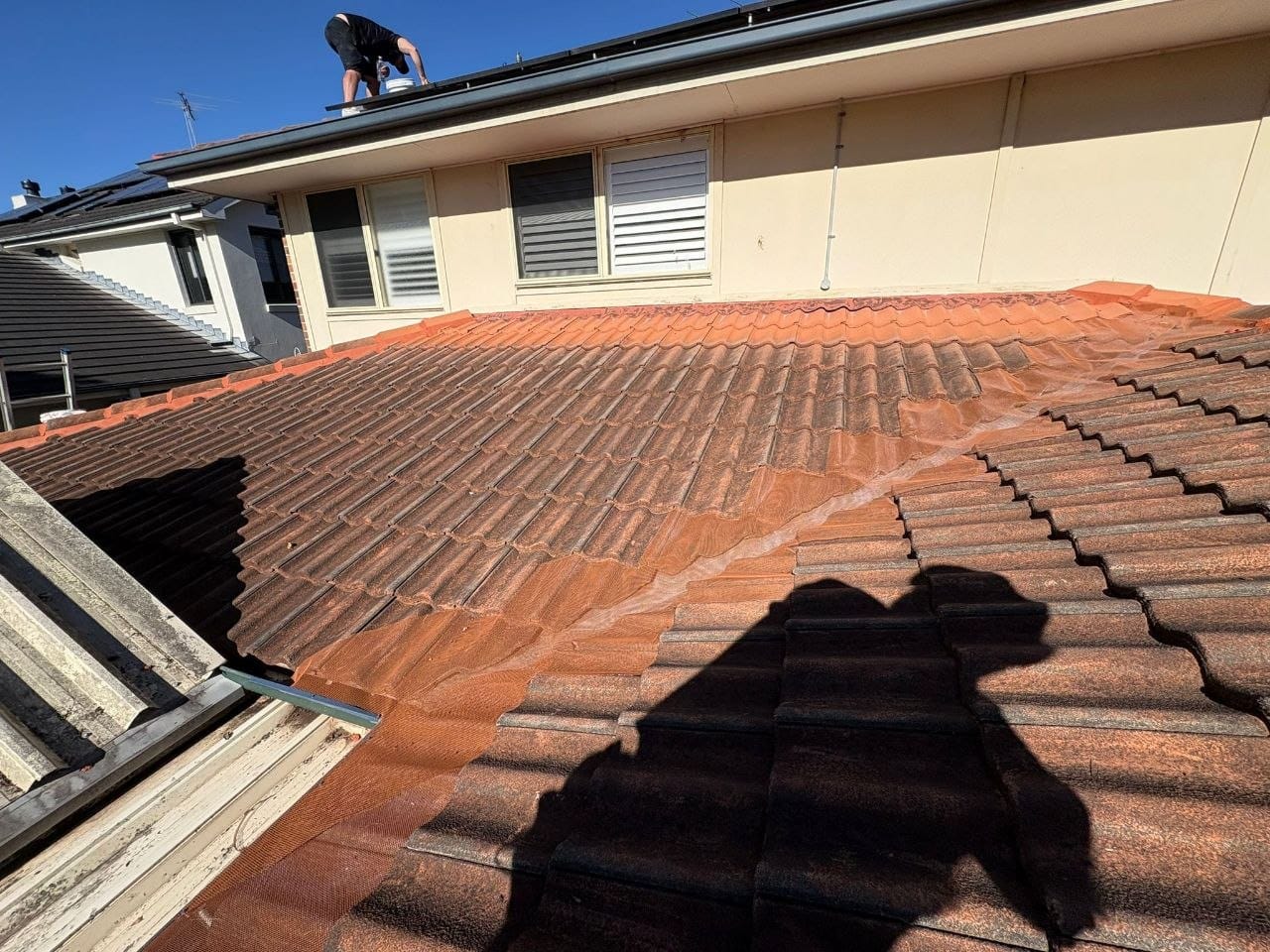
The roof is cleaned at 3,000 to 4,000 psi to strip moss, lichen, dirt and the loose, chalky surface off the tiles. On concrete this takes off a surprising amount of material; the wash water runs brown for most of the job. Downpipes are filtered or disconnected so the sludge does not block the stormwater. A roof that is not cleaned properly is the main reason coatings peel: the membrane bonds to the dirt, and then the dirt lets go.
3. Ridge cap re-bedding and re-pointing
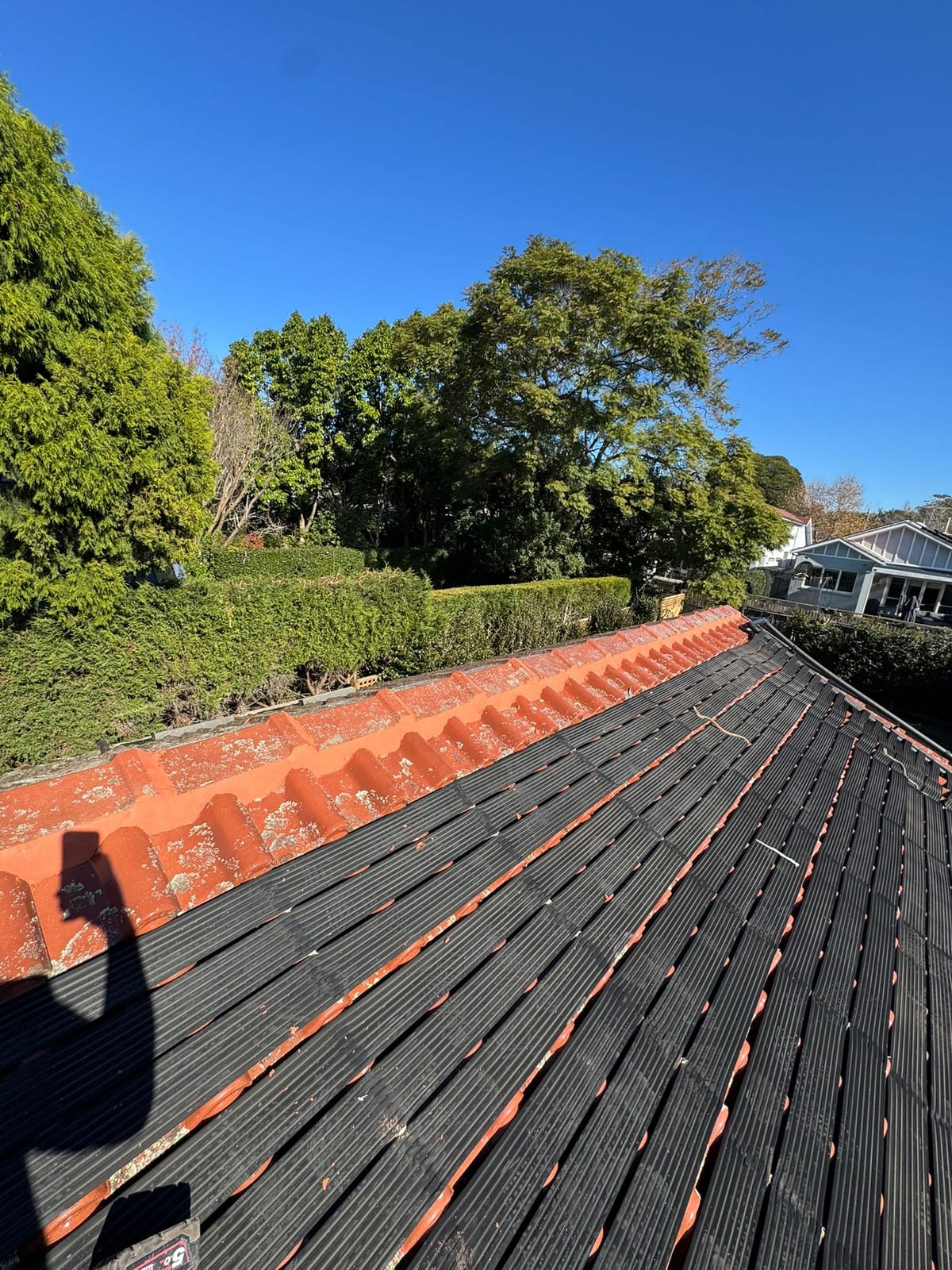
The ridge and hip caps are lifted, the old bedding chipped out and a new sand-and-cement bed laid. The caps are set back straight and level. Then they are pointed with a flexible pointing compound rather than rigid cement mortar; flexible pointing moves with the roof through summer heat and does not crack the way the original did. Some quotes include only re-pointing over the old bedding. On a roof more than 20 years old that is not a restoration, it is a cosmetic patch, and it is the first thing to check when one quote is well under the other two.
4. Roof primer
A roof primer goes on the clean, dry roof. On porous concrete tiles it soaks in and binds the surface; on terracotta it is a bonding primer; on metal it is a rust-inhibiting primer applied after any rust has been treated. The primer is what the membrane sticks to. Skipping it, or applying it before the roof has dried out after the clean, is the second most common cause of peeling.
5. Membrane coating, two coats
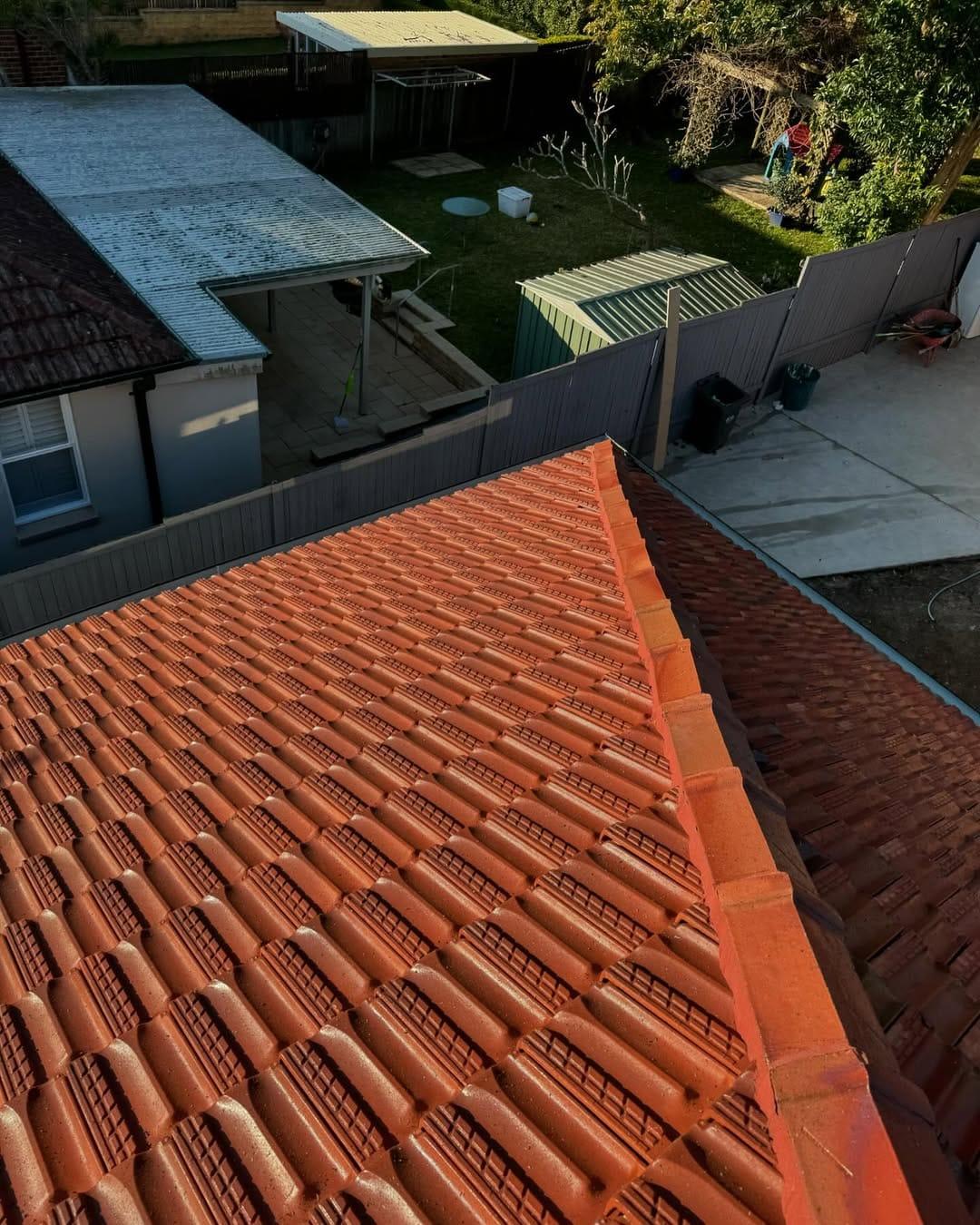
Two coats of acrylic membrane coating are sprayed on with airless equipment, each coat in a different direction so no area is missed. Two coats is the manufacturer's specification for the warranty; one heavy coat does not cure the same way and will not carry the 10 year coating warranty. Drying time between coats usually makes the coating stage a two-day job on its own.
Products and colour selection
We use Dulux AcraTex roof membrane systems and Shieldcoat as our standard coatings. Both come in heat-reflective versions that measurably drop roof-cavity temperature in summer, worth specifying on a west-facing roof in the Hills or Western Sydney. Dulux AcraTex carries a manufacturer warranty of up to 10 years, and most premium coatings are rated 10 to 15 years; the exact term depends on the product, the number of coats and the surface it goes over.
Colour selection is more flexible than most people expect. The coatings are tinted to the Colorbond colour range and to custom colours, so a faded 1980s brick-red concrete roof can come back as Monument, Surfmist, Woodland Grey or its original colour. Lighter colours reflect more heat; darker colours hide dirt longer. We bring sample swatches to the quote and can spray a test patch on the roof before you commit. Our Colorbond colour guide covers the full range.
Roof restoration cost in Sydney
For a typical three-bedroom single-storey home of 180 to 220 m², a full tile roof restoration starts from $4,500 including GST. A two-bedroom cottage, duplex or villa of 120 to 160 m² starts from $3,800. Metal roof restoration (clean, rust treatment, primer and two coats) is from $3,500 on a roof that small. If the roof is already sound and only needs colour, roof painting alone is from $2,400. How far a job goes above the starting price comes down to ridge length, bedding condition, pitch, access and scaffold, and the coating you choose. Our roof restoration cost guide breaks each of those down with worked examples.
How long it takes and what to expect
A single-storey restoration takes three to five working days across a week, weather permitting: a day for repairs and the clean, a day for bedding and pointing to cure, and two days for primer and coats. Two-storey and steep roofs take longer and need scaffold or edge protection to AS/NZS 1891. Cleaning day is noisy, and on coating days we mask windows, paths and anything parked nearby; cars off the driveway and pets inside, please.
When restoration is the wrong fix
We turn down restoration jobs when the roof will not hold a coating. Concrete tiles that are soft right through, terracotta that is fretting (glaze flaking, clay powdering), or a roof with sagging battens or rot in the timber, need roof replacement. Coating those roofs wastes the money; the tiles keep breaking down under the paint. If your roof is metal and rusted through at the laps, re-sheeting is usually not much dearer than restoring it.
Small faults do not need a full restoration either: a few broken tiles or one failed ridge is a repair, and a roof coated a few years ago that is sound but dirty needs a maintenance clean and inspection, not another coat.
Warranty and where we work
Every restoration carries our 2-year workmanship warranty on the repairs, bedding and application, on top of the manufacturer's coating warranty. We are licensed NSW roofers based in Gladesville and restore roofs across all nine Sydney regions, from Ryde and the North Shore to the Inner West, Hornsby, the Hills, the Northern Beaches, the Eastern Suburbs, Western Sydney and the Sutherland Shire. Book a free on-site quote and you will have a written, itemised price, usually within 24 to 48 hours.