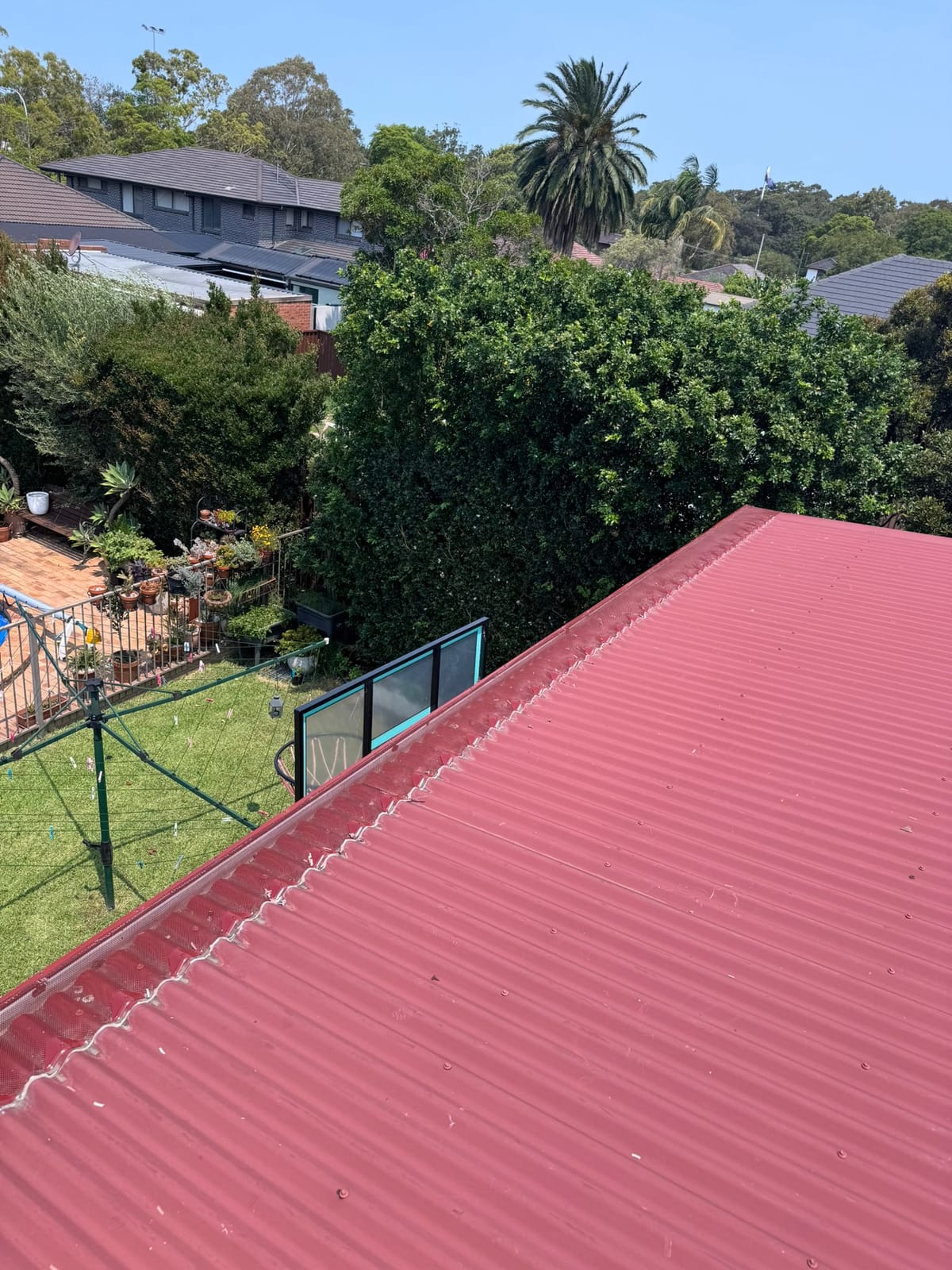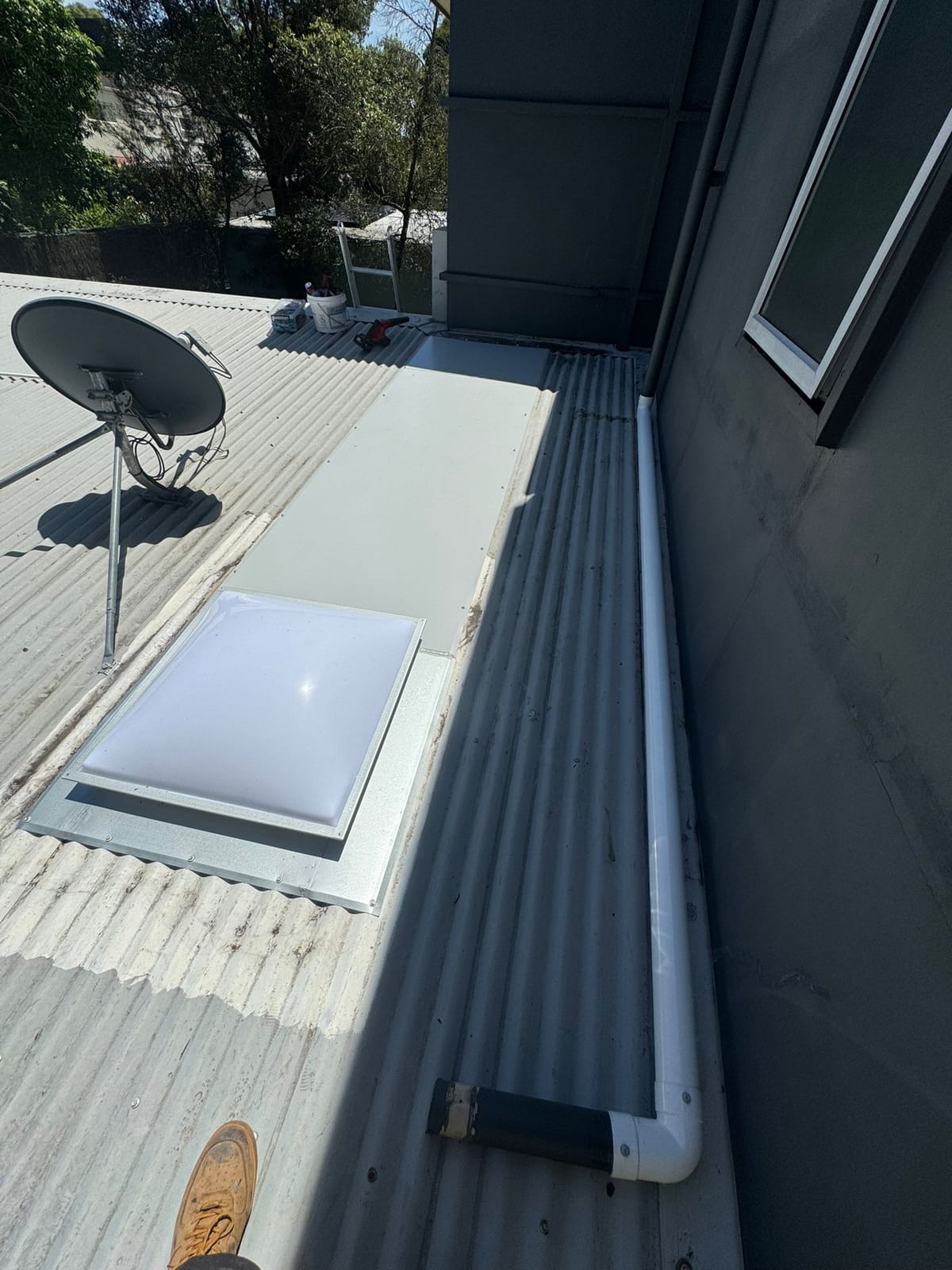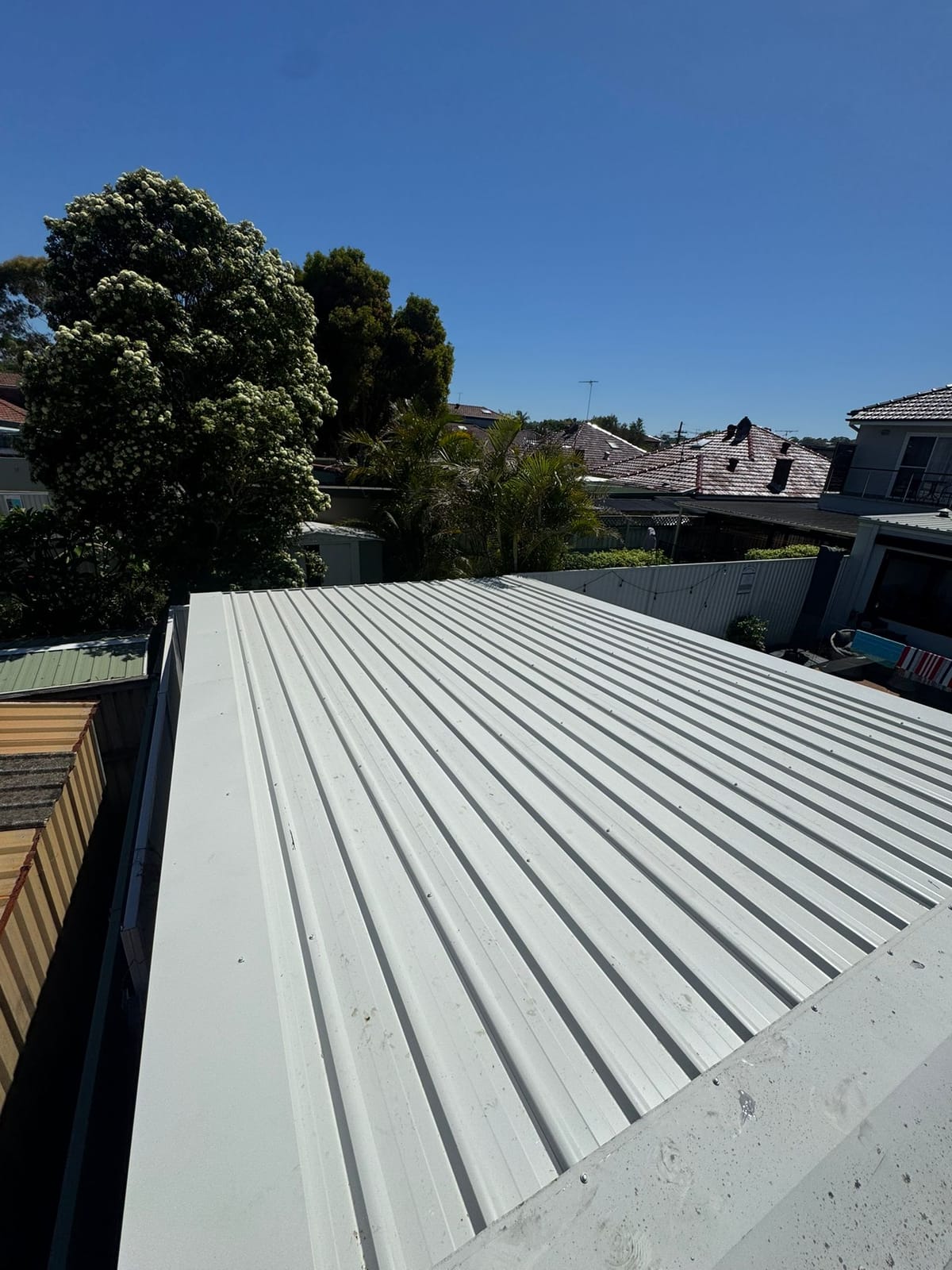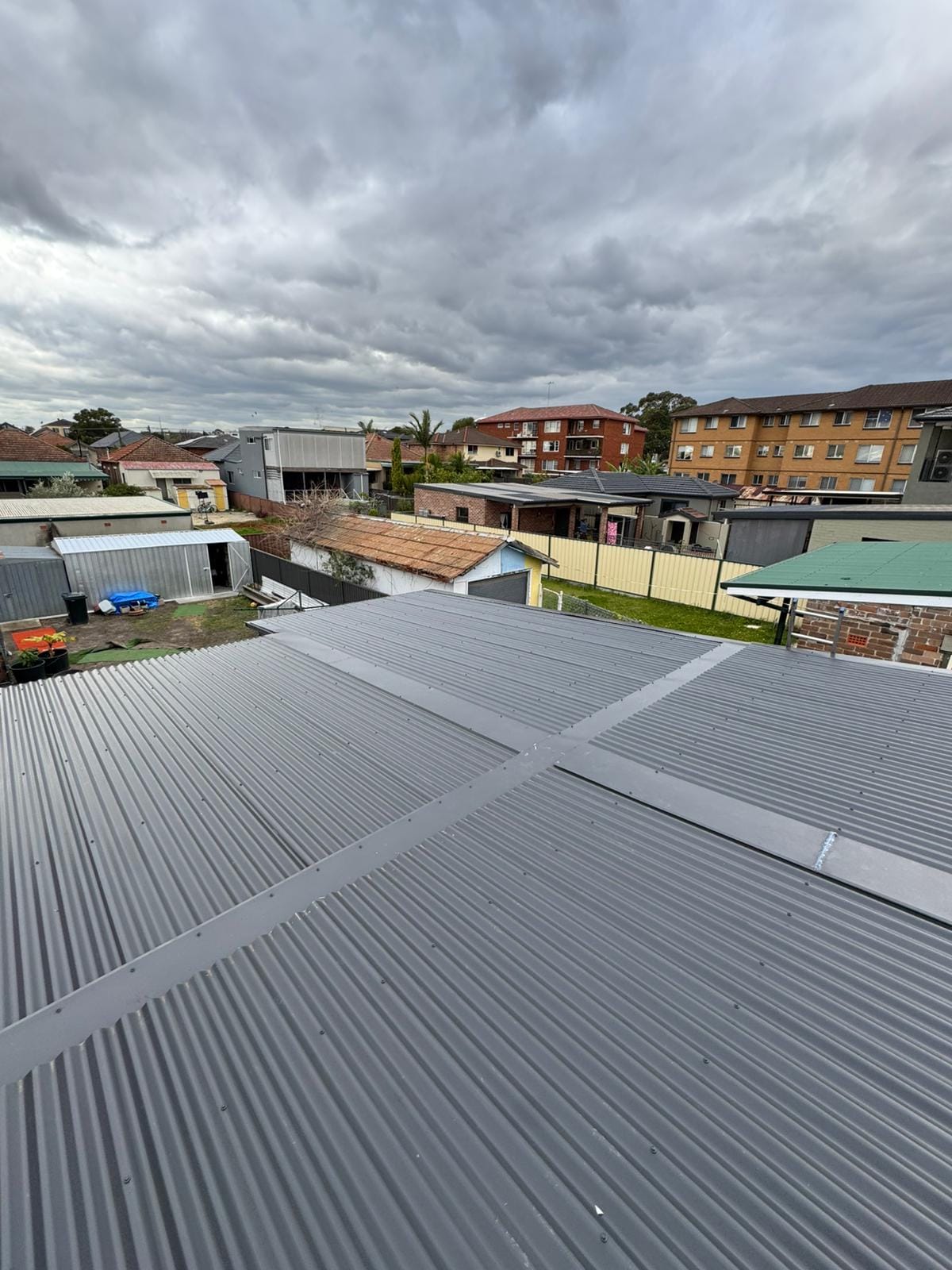
What we do with metal
Three kinds of work make up most of it. New Colorbond over an existing frame, usually a tile roof coming off and steel going on. Re-sheeting an old metal roof that has rusted past saving. And repairs to a roof that otherwise has years left. If you are still deciding between tile and metal, read tile vs Colorbond first; it is not always metal.
The steel
Colorbond is BlueScope's pre-painted steel: a Zincalume core with a paint system baked on. Standard residential sheeting is 0.42 mm base metal thickness; 0.48 mm goes on commercial roofs and anywhere with foot traffic.
Zincalume is the same steel without the paint. Cheaper, very reflective, and fine on sheds, carports and warehouses. On a house it glares and weathers unevenly.
Colorbond Ultra is the marine-grade product for homes within a few hundred metres of breaking surf: Manly, Cronulla, Coogee, Mona Vale. Standard Colorbond in that band rusts at the cut edges and screw holes well inside its warranty period, and the warranty will not cover it because the wrong product was specified. Ultra costs from 20 per cent more.
The BlueScope warranty
BlueScope backs Colorbond with a warranty of up to 36 years against corrosion, depending on the product and how far the roof is from salt water. It applies when the roof is installed to their conditions: the right product for the environment, compatible fixings, no lead touching the steel, no contact with copper or treated pine, and swarf swept off before it rusts into the paint. A roofer who runs lead flashing onto a Colorbond roof has voided it on day one.
The profiles
Custom Orb is the corrugated sheet everyone recognises, 16 mm rib at 76 mm centres. Suits pitches of 5 degrees and up, which covers most Sydney houses, and it is the profile heritage-minded councils prefer on older homes. Screw-fixed through the crest.
Trimdek is the trapezoidal profile with a 29 mm rib. It handles pitches down to 2 degrees, carries more water per sheet, and gives the flat, modern look on a skillion or extension. Also screw-fixed through the crest.
Klip-Lok is a concealed-fix profile. The sheets snap onto clips screwed to the battens, so there is no screw hole through the sheet anywhere. Rated down to 1 degree, which makes it the profile for near-flat roofs, long runs and commercial decks.
Standing seam is the architectural option: narrow flat pans with a folded upstand seam, in thin Colorbond or zinc. Beautiful, slow to install, and a multiple of Custom Orb per square metre. We price it per project. Pitch usually decides the profile before taste does.
Colour
The Colorbond colour range has 22 core colours plus a small Matt range. Two dominate Sydney. Surfmist is the pale off-white with the highest solar reflectance in the range; it keeps a roof cavity noticeably cooler in a Penrith summer. Monument is the dark charcoal on most modern builds in the Hills and the Inner West. It runs 10 to 15 degrees hotter on the surface than Surfmist on the same afternoon, which is fine if the blanket underneath is doing its job and a mistake if it is not.
In a heritage conservation area council will usually want a traditional colour on Custom Orb. Popular choices and heat performance are in Colorbond colours for Sydney homes.
Under the sheets
Anti-condensation blanket. Foil-faced glasswool blanket laid over the battens under the sheet. On a cold, clear night the underside of bare steel drops below the dew point and sweats, and the drips land on the ceiling in the morning. The blanket stops that, adds R-value, and takes the drumming out of rain. We do not lay a metal roof over living space without it.
Sarking and battens. On a conversion the old sarking comes out with the tiles and is replaced to AS 4200.1 under the blanket. Tile battens are too close together and too light for metal, so steel top-hat battens go across the rafters at the spacing the profile calls for.
Thermal expansion. Steel moves. A 12 metre run of Colorbond grows and shrinks a few millimetres between a winter night and a 40 degree afternoon, and the roof ticks as it does it. Screw-fixed sheets on long runs need the fixings and flashings detailed to allow for that movement, or the screw holes elongate and become leaks. Klip-Lok clips let the sheet slide, which is why it suits very long runs.
Fixings. Class 4 screws with EPDM washers, to AS 1562.1; stainless on the coast. Fall protection to AS/NZS 1891 goes up before anyone walks the frame.
A tile-to-metal conversion, step by step
- Measure and order. Sheets are cut to length by the rollformer, so we measure every plane and penetration on the quote visit.
- Strip. Tiles come off in a day on an average house. Any pre-1990 roof is checked for asbestos cement in the eaves or flashings; if it is there, a licensed removalist does that part.
- Frame check. Metal is a third of the weight of tiles, so the frame is never the problem, but we fix any rot or sag while it is exposed.
- Battens and blanket. Top-hat battens, then sarking and the anti-condensation blanket, lapped and taped.
- Sheets. Laid from the end away from the prevailing weather so the laps face away from the rain. Screwed through the crest on Custom Orb and Trimdek, clipped on Klip-Lok. Swarf is swept off every sheet.
- Flashings. Ridge, barge, apron and wall flashings in matching Colorbond, folded on site. Vents, flues and skylights get proprietary boots or soaker flashings, not silicone.
- Gutters. Old gutters usually go with the tiles. New Colorbond gutter and downpipes are quoted with the roof; see gutter replacement.
- Clean and register. Magnet sweep of the yard, photos, and the BlueScope warranty registered.
An average three-bedroom home is three to five days for a crew of three. We do not strip more roof than we can sheet and make weathertight the same day.
Repairs to an existing metal roof
Most metal roof repairs are one of four things: replacing perished screws and washers (a day's work that stops a hundred small leaks at once), replacing a rusted sheet, re-dressing a lifted flashing, or cleaning and coating a roof that is sound but tired. Small repairs are on the roof repairs page.
What it costs
New Colorbond sheeting over an existing structure starts from $120 per square metre supplied and installed, including battens and blanket; Colorbond Ultra adds from 20 per cent. A full tile-to-Colorbond conversion starts from $14,400 for a small home with about 120 m² of roof, with stripping, disposal and flashings in that rate and new gutters as a separate line. The breakdown is in roof replacement cost in Sydney. Quotes are free, written and measured on the roof.
When metal is the wrong answer
- A heritage-listed house or a conservation area where council will only approve tile or slate.
- A sound tile roof that only needs a restoration. Converting it spends three times as much to solve a problem a re-bed and coat would fix.
- A pitch under 1 degree. That is a membrane roof, not a sheet roof.
- A pergola or patio, which is polycarbonate roofing, a different sheet entirely.
Warranty and where we work
Every metal roof we lay carries our 2-year workmanship warranty on top of the BlueScope material warranty, which we register to your address. We are based in Gladesville and install Colorbond roofing across Sydney, most often on the North Shore, in the Inner West, the Hills and the Eastern Suburbs. Book a free on-site quote and we will bring colour swatches and a profile sample.