
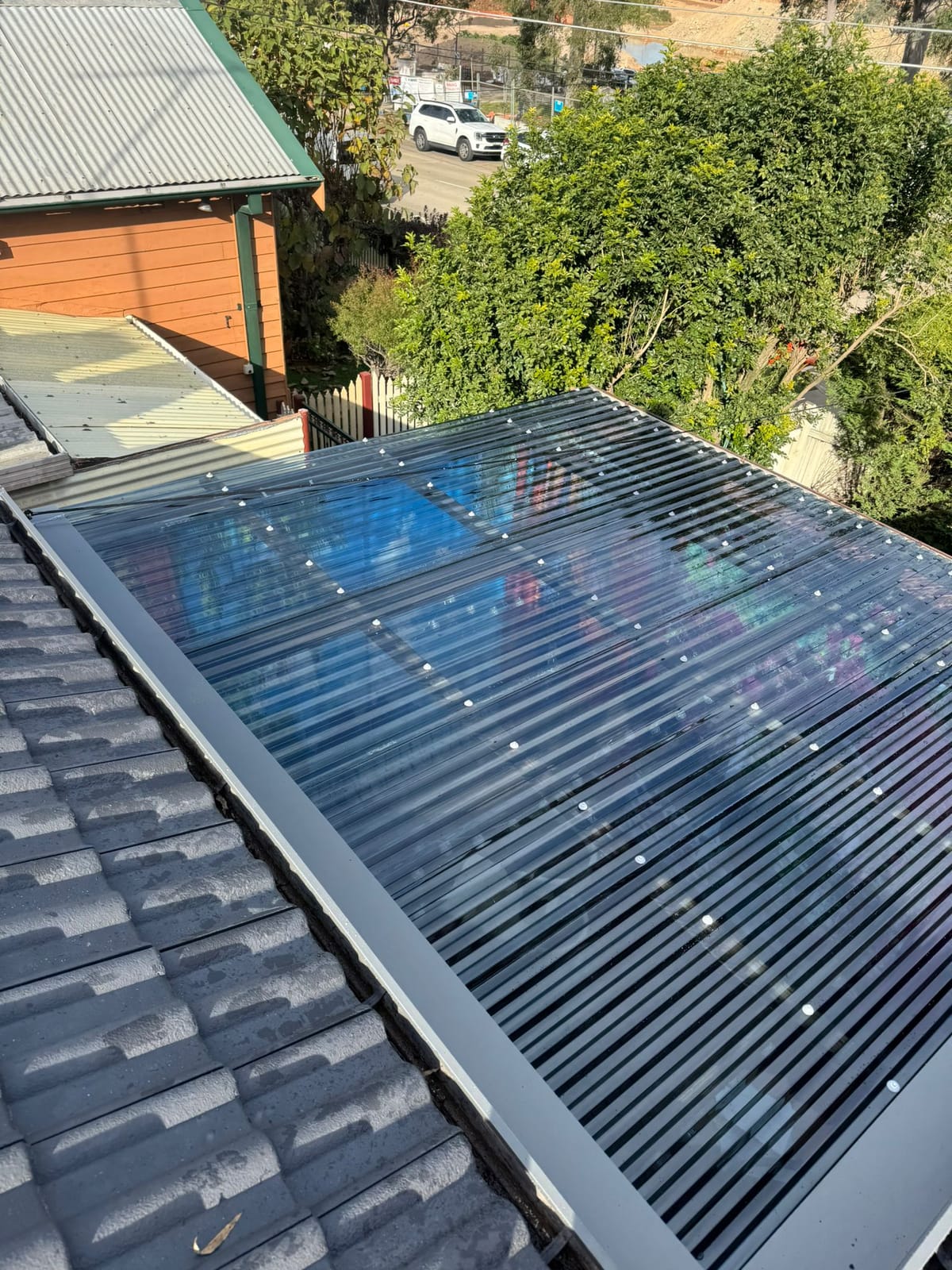
Choosing the sheet: Laserlite, Suntuf or Solasafe
Corrugated polycarbonate is sold in Sydney under three main names: Laserlite (the Laserlite 2000 and 3000 ranges), Suntuf, and Solasafe. All are UV-stabilised polycarbonate in the same corrugated and Greca profiles as standard metal roofing, and all are a big step up from the old fibreglass that goes yellow and brittle after ten summers. The differences that matter are grade, colour and price.
| What it is | Where it makes sense | |
|---|---|---|
| Laserlite 2000 | Standard grade, clear and a range of tints | Pergolas where you want the light and can live with the heat |
| Laserlite 3000 | Higher-grade sheet with a heat-reducing treatment | North and west-facing patios that cook in January |
| Suntuf | Standard grade, wide colour range, the hardware-store staple | Carport roofing, side awnings, budget pergola roofs |
| Suntuf SolarSmart | Suntuf's heat-reflective grade | Same use as Laserlite 3000; pick on colour and availability |
| Solasafe | Ampelite's range, standard and heat-reducing grades | Often the best price through roofing suppliers |
Every one of these has a UV protection layer co-extruded onto one face, and that face goes up. Laid upside down, the sheet hazes and goes brittle within a few years and the warranty is void. The protective film is marked; leave it on until the sheet is fixed.
On colour: clear lets in the most light and the most heat. Grey and bronze tints cut glare and some heat. Opal diffuses light and hides dirt. The heat-reflective grades let you keep a light colour and still knock the heat back. The manufacturers publish light and heat transmission figures for every colour; read them before you buy.
Sheet thickness and purlin spacing
Two things decide whether a polycarbonate roof lasts or sags and cracks. Sheet thickness is the first: standard corrugated sheet is around 0.8 mm, and the premium ranges are slightly thicker and stiffer, so they span further and take hail better. The second is purlin spacing. Each manufacturer publishes a span table, and for corrugated sheet the supports need to be closer together than for metal, with the end spans tighter than the middle ones. A pergola built for fibreglass or Colorbond often has purlins too far apart for polycarbonate, and the sheet flaps in wind and eventually cracks at the screws.
The fix is intermediate purlins or a stiffer sheet. We check the spacing against the manufacturer's table before quoting and tell you if the frame needs work.
DIY or hire a roofer?
Honest answer: a small, single-storey pergola roof on a level backyard, with sound purlins at the right spacing, is a reasonable weekend job for someone comfortable on a ladder. The sheets are light, cut with a fine-tooth saw or shears, and fix simply. Buy the manufacturer's own screws (they have a large sealing washer sized for polycarbonate), pre-drill every hole oversize so the sheet can expand in the heat, fix on the crest never the valley, and lap the sheets away from the prevailing weather.
Where it stops being a DIY job:
- The roof is over a deck, two storeys up, or above a drop you would not want to fall
- The purlins are rotten, undersized or need re-spacing, so it is a carpentry job as well
- The pergola attaches to the house and the old sheeting leaked at the wall, which means the back flashing or apron flashing needs redoing, not just the sheets
- It is a steel carport frame that needs self-drilling screws and proper fall to the gutter
- It is an insurance job and the insurer wants a licensed contractor's invoice
- The job is worth more than $5,000, where NSW law requires a licensed contractor anyway
Falls from pergola roofs put a lot of weekend DIYers in hospital. If any of the above applies, get a quote. It is free.
How we install it
A typical pergola runs like this:
- Strip the old sheeting and check every purlin. Rotten timber is replaced; steel is checked for rust at the fixings.
- Check the fall. Polycarbonate needs at least 5 degrees to shed water; flatter than that it ponds, grows algae and leaks at the laps.
- Confirm purlin spacing against the span table for the sheet you have chosen. Add purlins if needed.
- Lay the sheets UV side up, starting at the end away from the weather so the laps face downwind. One and a half corrugations of side lap on corrugated, one rib on Greca.
- Pre-drill every fixing hole 10 mm oversize. Fix on every second crest at the ends and every third mid-span with polycarbonate screws and sealing washers. Do not over-tighten; the washer should just compress.
- Fit the ridge or apron flashing where the roof meets the house, with a back channel if the old one has gone. This is where most pergola roof leaks start.
- Fit or refit the gutter and check the downpipe runs somewhere sensible, not onto the deck.
- Clean up and take the old sheets away.
Most pergola and carport roofs are done in a day; a large patio with new purlins and a wall flashing is two.
Hail damage and repairs
Polycarbonate handles Sydney hail well; it flexes rather than shatters, and most of the hail damage we see on patio roofs is old fibreglass that has gone brittle and been punched through. If your sheet has holes after a storm, it is almost certainly fibreglass and it is time to replace, not patch. Genuine hail damage to polycarbonate is rare and usually means a sheet fixed too tight or laid UV face down. For a cracked sheet or two, we replace the individual sheets; see roof repairs for how small jobs are priced.
Should it be polycarbonate at all?
Not always. If the patio faces west and you sit under it in summer, a light-coloured Colorbond roof in Surfmist or similar will be cooler and quieter in rain than any polycarbonate. The trade-off is light: a metal roof over a patio can make the room behind it dark. A common compromise is Colorbond with one or two clear polycarbonate sheets over the doorway. Metal costs about the same per square metre, so pick on light and heat, not price.
What it costs
Re-sheeting is priced per square metre installed, with sheet grade, purlin work and flashing moving the number. The table below gives the starting prices. If you are weighing DIY against hiring us, the material alone for a standard pergola is usually a third to half of the installed price; the rest is labour, flashings, fixings and disposal.
Warranty
Our workmanship is warranted for 2 years. The sheet carries the manufacturer's warranty against yellowing, loss of light and hail breakage, conditional on correct installation, which is the main reason to install it to the manual: an upside-down or over-tightened sheet has no warranty at all.
When you are ready, book a free on-site quote and we will measure the frame, check the purlins and give you a written price for the sheet you want.