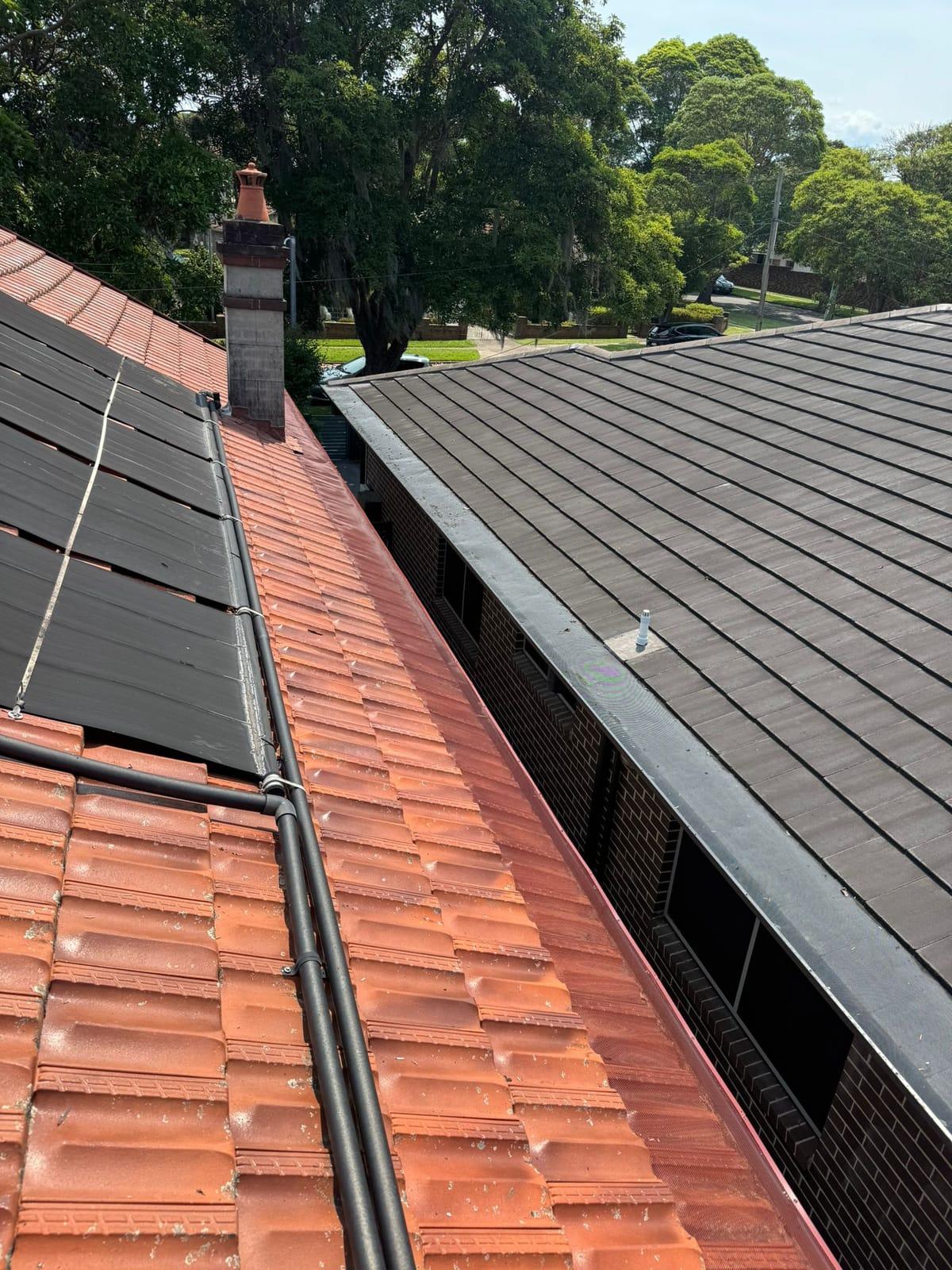
Gutter cleaning under the northern district canopy
Nowhere in Sydney fills a gutter faster than the streets between Epping and Hornsby. Blue gums, turpentines and blackbutts along the bushland edges, and liquidambars, jacarandas and camphor laurels planted along the older streets, drop enough litter that a single-storey home in Beecroft or Pennant Hills can have its gutters packed solid twice a year. Our gutter cleaning page covers what a standard clean includes anywhere in Sydney. This page is about why the district needs it more often, what it costs on the taller and steeper homes, and how it ties into bushfire season.
What gum litter does to a roof
Gum leaves do not behave like deciduous leaves. They are waxy, they do not break down quickly, and they pack into a dense mat that holds water. In a gutter that mat sits against the back of the gutter and the fascia through winter, and on the 1960s to 80s homes across Hornsby and Carlingford, that is why the fascia is rotten at the corners and the gutter has rusted through from the inside. In a valley, the same mat rusts the valley iron from underneath and the first sign is a ceiling stain in the room below.
The downpipes go next. Silt and bark strips wash down and block the bend at the bottom, the gutter backs up, and the overflow runs behind the fascia into the eaves. We flush every downpipe on every clean because a clear gutter draining into a blocked pipe is not a clean.
How often, by suburb
| Location | Tree cover | Recommended |
|---|---|---|
| Beecroft, Pennant Hills, Hornsby bush-edge streets | Heavy gum canopy | Twice a year, autumn and spring |
| Hornsby, Thornleigh, Epping (older streets) | Mixed mature trees | Annually, before summer |
| Carlingford, Epping (newer streets and units) | Lighter cover | Every 12 to 18 months |
The autumn clean gets the leaf drop out before the winter rain. The spring clean is the bushfire one.
Ember season on the bushland edge
A large part of Hornsby Shire sits on the bushfire prone land map, and homes backing onto Berowra Valley, Lane Cove National Park and the reserves around Pennant Hills and Thornleigh carry BAL ratings under AS 3959. Embers arrive well ahead of any fire front, and a gutter full of dry gum leaves is the most flammable thing on the house. The RFS Get Ready checklist puts clearing gutters near the top for a reason.
For BAL-rated homes we recommend the spring clean be done by late October. For anyone who does not want to think about it every year, ember-rated gutter guard from $45 per lineal metre stops the leaves getting in at all, and we can fit it on the same visit once the gutters are clear.
Access on two-storey and steep homes
This is where the district's prices differ from flat suburbs. A lot of Thornleigh and western Hornsby homes are single storey at the street and two or three at the back, with a sloping yard and no level ground for a ladder. We bring the right gear rather than stretching a ladder: a tower or EWP for the high side, harnesses to AS/NZS 1891 on the roof, and a gutter vacuum for the runs we cannot reach by hand safely. A two-storey clean costs more for that reason, and we would rather say so in the quote than send someone up a ladder on a slope.
Epping's apartment blocks
The strata buildings around Epping station have box gutters and flat membrane roofs rather than eaves gutters, and those need checking as much as cleaning: a sump, overflow or outlet blocked by a single plastic bag can flood a top-floor unit in one storm. We do scheduled cleans for strata managers with a photo report for the committee each visit.
What it costs in the district
Single storey, from $250. Two storey, from $400. Both include the downpipe flush and a photo report of what we found on the roof, which for a lot of Hornsby homes is where the first sign of a ridge or valley problem turns up. Annual and twice-yearly schedules are priced a little lower than one-offs.
You can see everything else we do across Hornsby and the northern district, or book a gutter clean and we will confirm a time within 24 to 48 hours.